Real-World Scenario
A maintenance team at a cold storage facility in Johannesburg is scheduled to replace roof insulation panels. The roof sits approximately six metres above floor level. The facility has no documented fall protection plan. No permanent anchor points have been installed.
Workers are given harnesses from a storage cupboard before the job starts. No one has checked whether the harnesses meet the required SANS standard. SANS stands for South African National Standard, the country's official body that sets technical specifications for equipment and systems. No one has checked whether the harnesses are still in safe working condition.
The contractor proceeds because no instruction to stop has been given. The employer has not checked which regulations apply to this type of work. Neither party has considered that South African law places specific and enforceable obligations on both of them.
This situation is not unusual. It reflects a gap that exists across many South African workplaces. The regulations are in place. They are simply not understood or applied.
The Risk
Working at height remains one of the leading causes of serious injury and workplace death in South Africa. When employers do not understand which regulations apply to their operations, they cannot build systems that meet the law. This creates two distinct categories of risk.
The first is physical risk to workers. Without compliant fall arrest systems and verified equipment, a fall can occur with nothing in place to stop it. The second is legal risk to the employer. Non-compliance with working at height safety regulations exposes the responsible party to investigation, enforcement action, and civil liability.
The point worth stating clearly is this: understanding which regulations apply is not a bureaucratic starting point. It is the foundation of every height safety decision a facility makes.
Technical Explanation
South Africa's regulatory framework for fall protection covers two layers. The first is primary legislation. The second is technical standards that specify how equipment must be designed, tested, and used.
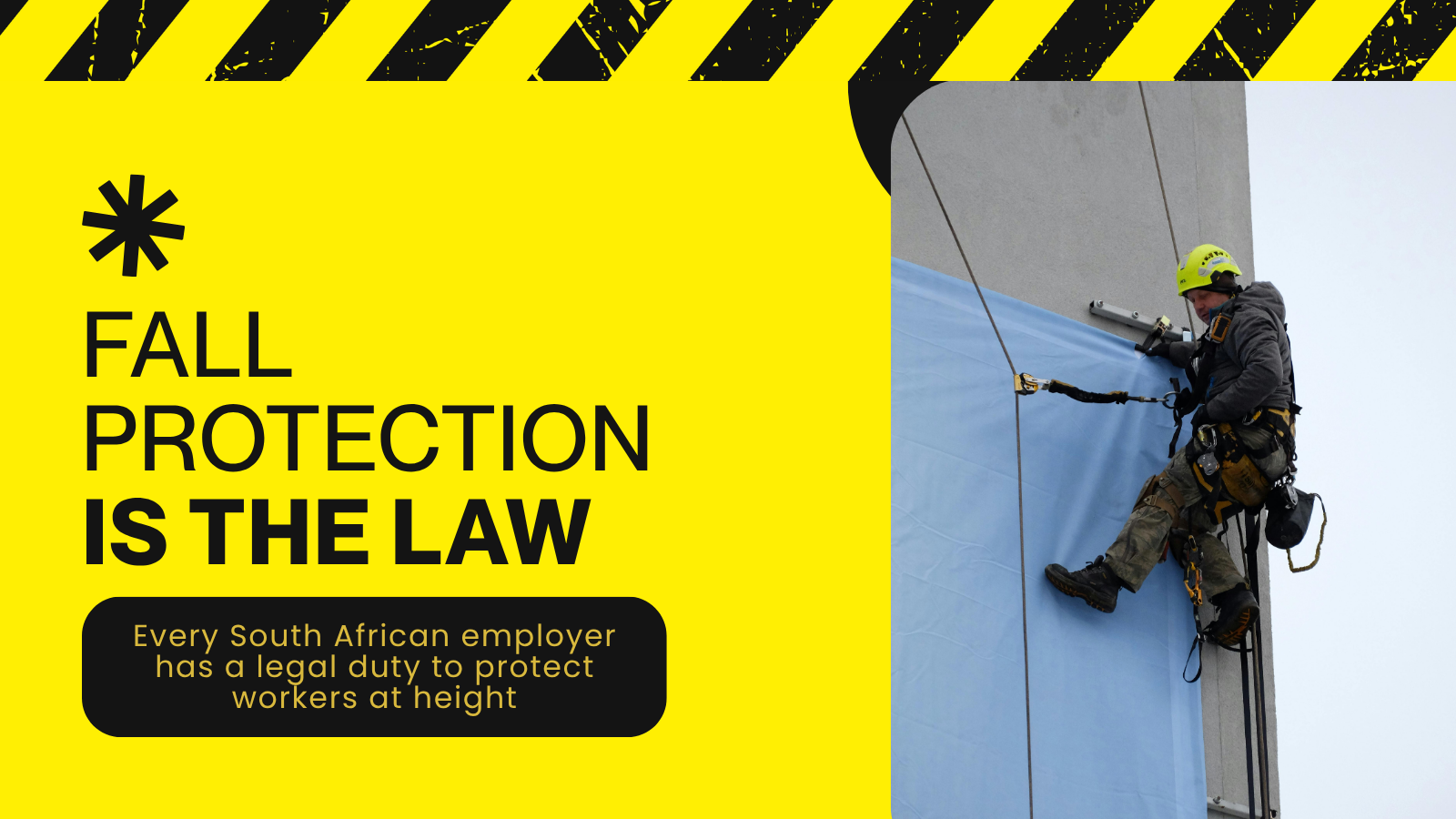
The primary legislation is the Occupational Health and Safety Act (OHSA), Act No. 85 of 1993. This act places a general duty on every employer to provide a safe working environment. It applies to all workplaces in South Africa. It is enforced by the Department of Employment and Labour.
Beneath the OHSA sit the Construction Regulations, 2014. These regulations apply to any construction work, which includes maintenance, renovation, repair, and installation work performed on structures. The Construction Regulations require every employer involved in construction work to prepare a written Fall Protection Plan before work at height begins. The plan must identify all fall hazards, specify control measures, and be kept on site at all times.
The SANS technical standards sit alongside this legislation and specify the performance criteria that equipment must meet. The key standards for working at height in South Africa include:
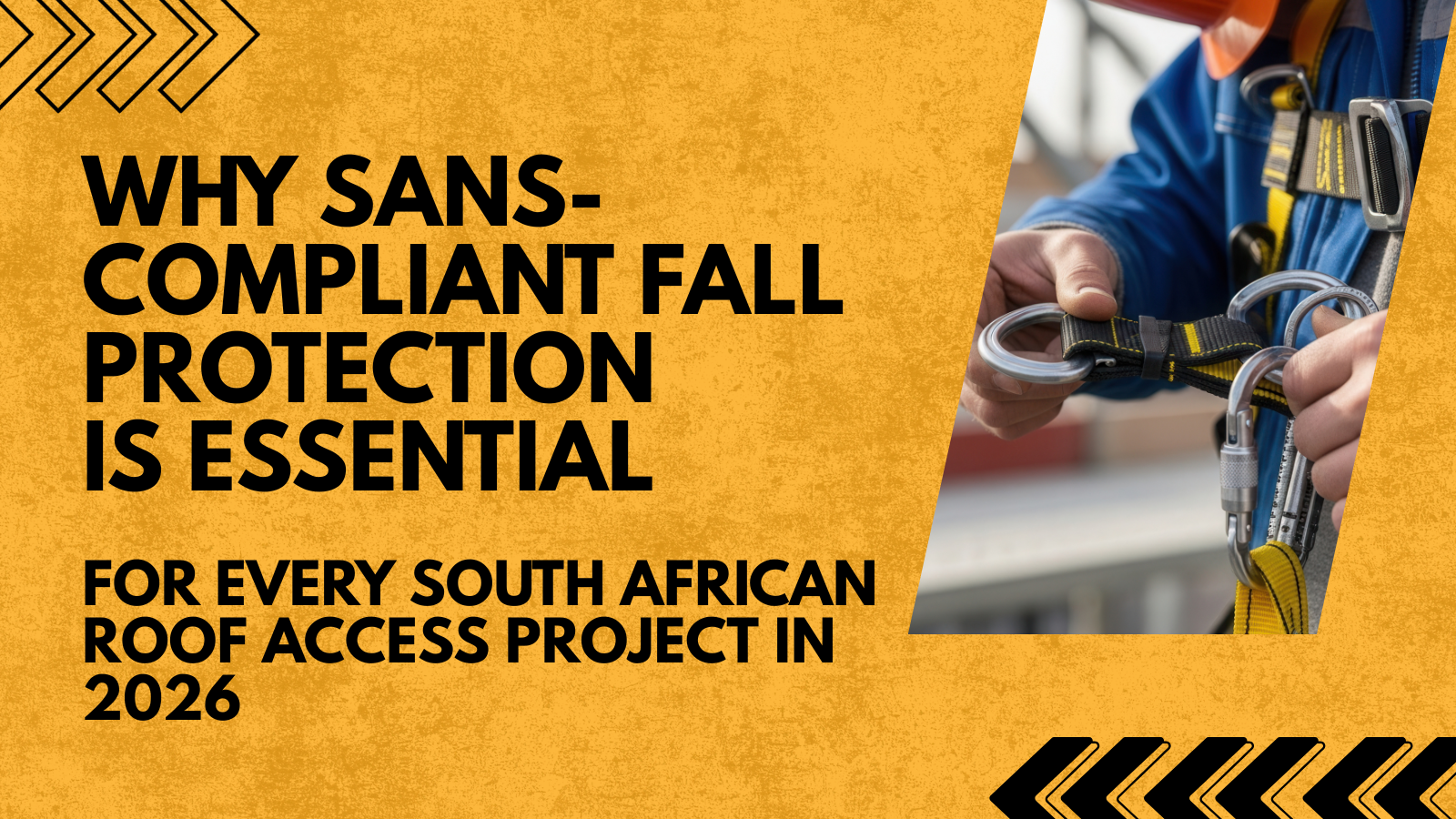
SANS 1808: This standard covers safety harnesses and lanyards used in fall arrest and fall restraint applications. Equipment used on site must conform to this standard to be legally compliant.
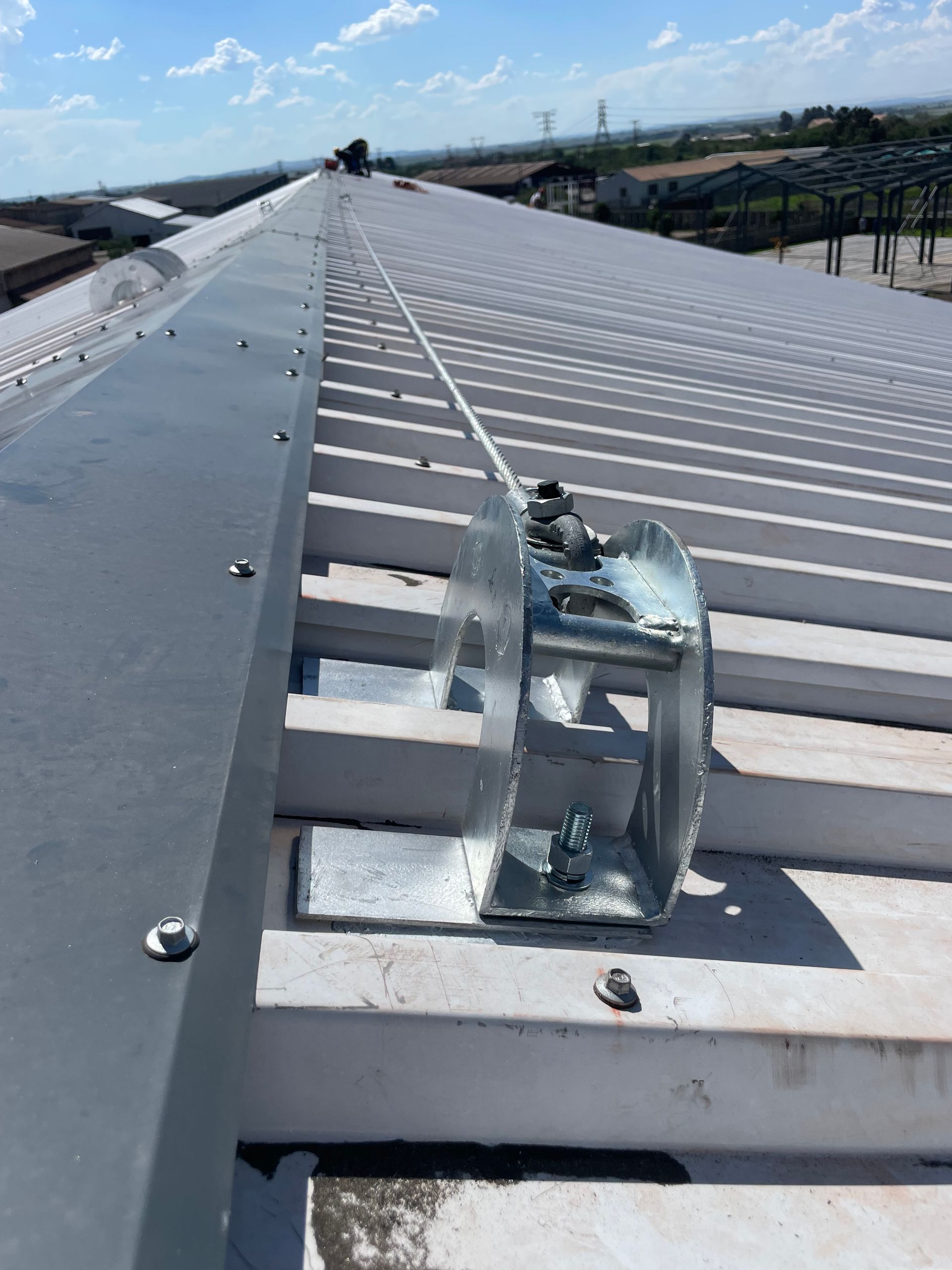
SANS 50795 (equivalent to EN 795): This standard covers anchor devices used in personal fall protection systems. It defines design, testing, and classification requirements for roof anchors and fixed anchor points.
SANS 10147: This standard covers portable ladders, including construction requirements, load ratings, and safe use.
SANS 1973: This standard sets requirements for industrial safety helmets used in work environments.
These standards do not function independently. A compliant height safety system must satisfy both the legislative requirements under OHSA and the technical requirements under the applicable SANS standards at the same time.
Compliance Layer (SANS and OHSA)
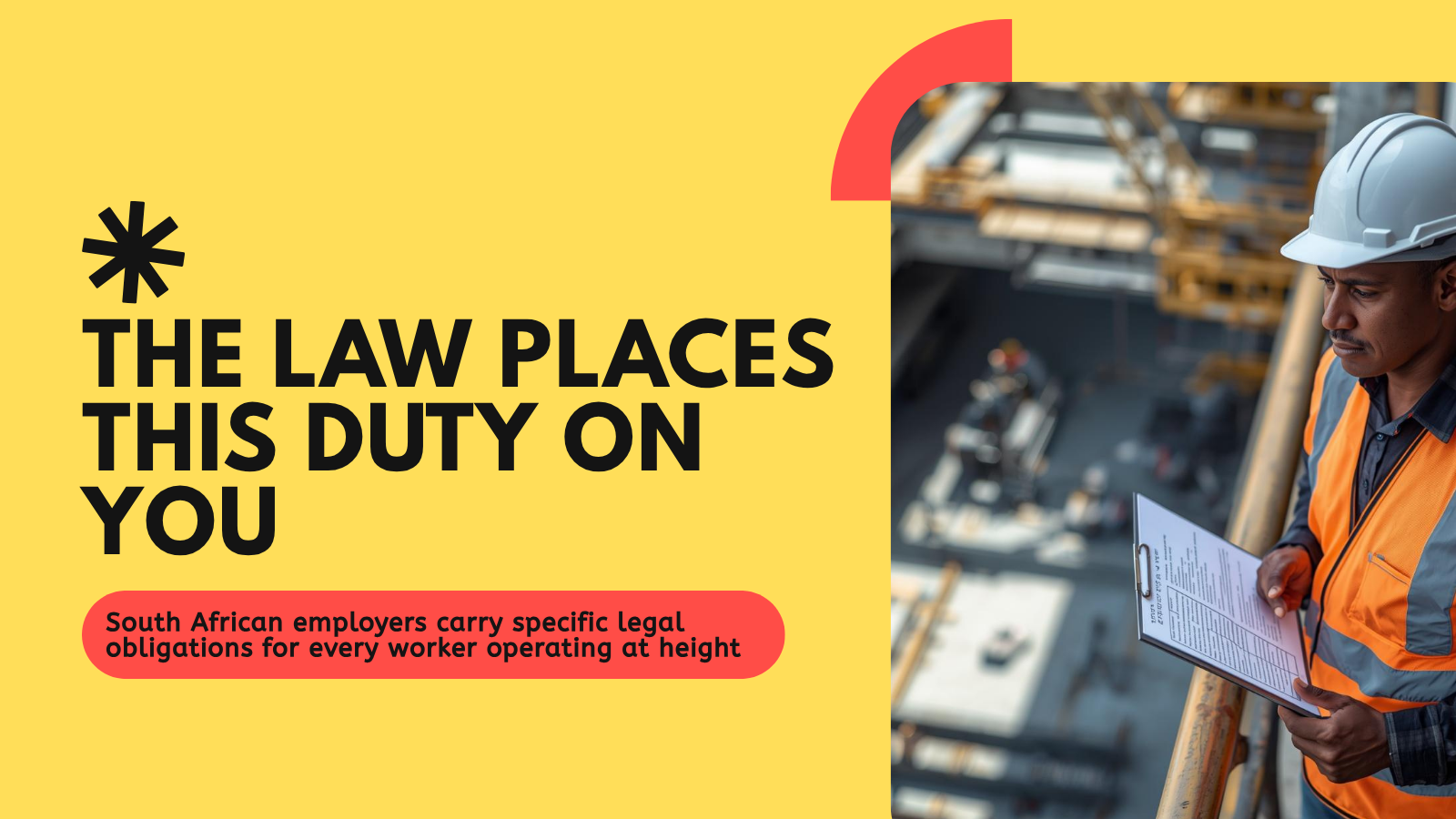
Under the Construction Regulations, 2014, the employer's legal obligations for working at height are specific and written down. A Fall Protection Plan is required before any work at height begins.
The plan must be prepared by a competent person. A competent person is defined as someone with the training, experience, and knowledge to assess fall hazards and specify appropriate controls. The plan must be updated whenever site conditions or the scope of work changes.
OHSA places an additional duty on employers to make sure that all plant and machinery is safe for use. This includes fall protection equipment. Equipment that does not meet the applicable SANS standard does not satisfy this duty, regardless of whether it looks serviceable.
Employers must also make sure that workers at height are trained. The Construction Regulations require documented training in the use of the specific equipment a worker will use. General safety induction does not fulfil this requirement.
Contractors share legal responsibility in this framework. Where a principal contractor appoints a subcontractor for work at height, the principal contractor must verify that the subcontractor's systems comply with the same regulatory requirements. A contractual clause shifting liability does not remove this obligation.
Practical Implementation
Achieving compliance with fall protection regulations in South Africa starts with a structured process. The steps below form the required foundation.
Step 1: Identify every task that involves work at height. South African law does not set a minimum height at which regulations begin to apply. Any height where a fall could cause injury falls within scope.
Step 2: Prepare or update your Fall Protection Plan. The plan must be specific to your site and to the tasks being performed. A generic document covering "all work at height" does not meet the requirement. Each distinct work activity must be addressed.
Step 3: Verify that all equipment meets the applicable SANS standard. Harnesses must conform to SANS 1808. Anchor devices must conform to SANS 50795. Equipment purchased without verification of compliance is not a safe assumption.
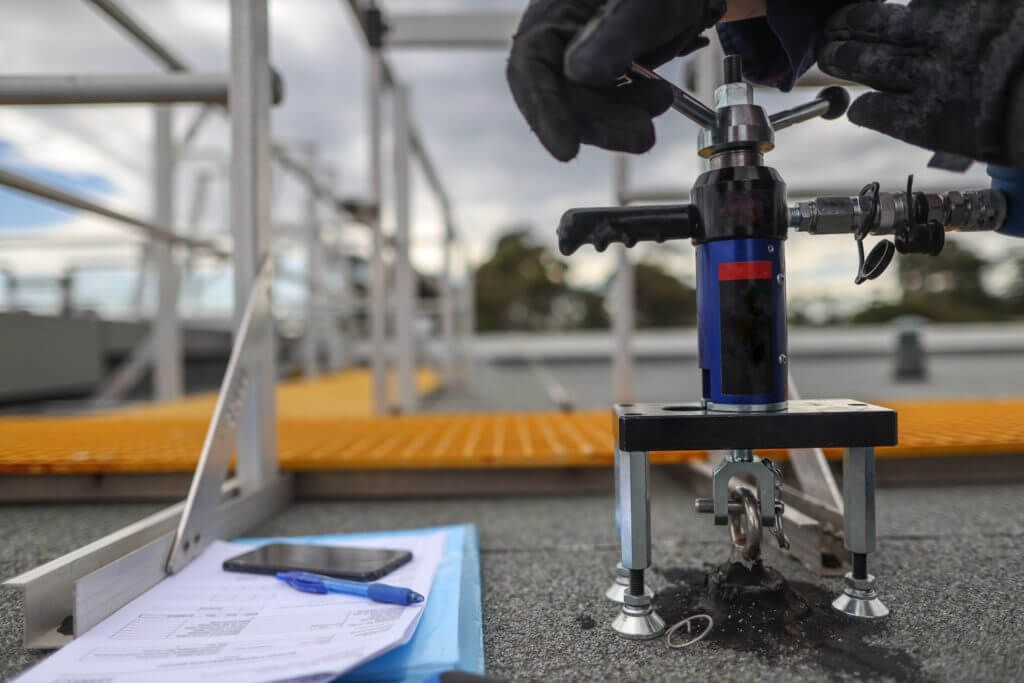
Step 4: Confirm that inspection records are current. OHSA requires that fall protection equipment is inspected at intervals set by the manufacturer and after any incident. Records must be kept and available for inspection. EMFab's inspection, testing and maintenance services are built to meet these record-keeping and inspection requirements.
Step 5: Document all training. Every worker who works at height must be trained on the specific equipment they use. Training records must be retained. This is a minimum requirement under the Construction Regulations, 2014.
For a full overview of compliant fall protection systems and the SANS standards that apply to each, visit EMFab's products and solutions page. A clear understanding of available system types helps employers match the right solution to their specific site conditions.
Employers cannot claim ignorance of the applicable regulations as a defence. South African courts and the Department of Employment and Labour hold employers to the standard of what a competent, informed employer should have known and done.
The consequences of non-compliance are concrete. A prohibition notice stops work immediately. Prosecution under OHSA can result in fines or imprisonment. Where a fall causes serious injury or death, civil liability claims follow. These consequences apply to the employer, the principal contractor, and in some cases to individual managers and directors.
The regulations governing fall protection in South Africa are not complicated once they are mapped against your operations. The obligation is to understand them, apply them, and keep documentation that proves you have done so. Employers who treat compliance as a formality rather than a functional risk control will find that the gap between those two approaches is exactly where liability takes hold.
For a detailed explanation of how technical standards are applied to specific systems, visit EMFab's standards and testing information.
If your facility requires a compliance assessment or fall protection inspection,
contact EMFab for a professional evaluation.